Eastbound Seafood chooses Maritech

We are happy to share the news that Eastbound Seafood chooses Maritech to boost efficient and timely delivery and traceability of their high-quality seafood products.

An integrated value chain

We are delighted to welcome Eastbound Seafood as the newest member of the Maritech DigitalSeafoodTM Purchase & Sales family, using our premiere cloud-based software suite for its sales operations across Canada, the USA, and Asia.

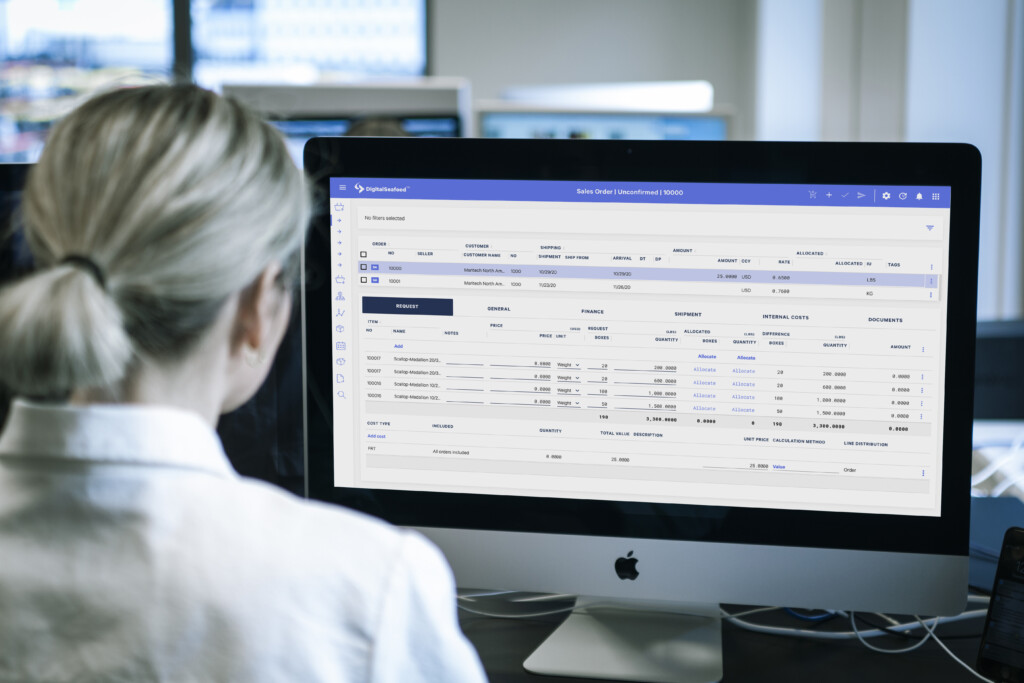
DGS Purchase & Sales is tailored to manage seafood sales by ensuring a full company overview, with stringent tracking and control operative throughout the value chain. Developed based on industry best practices, the solution is the core tool in our cloud based DigitalSeafood™ platform in Microsoft Azure.

“Our company has worked closely with local seafood producers and built a network of connections and markets across Canada and internationally. In adopting Maritech’s cloud-based tools, we can further ensure visibility and collaboration throughout our entire supply chain, digitally integrating buying, selling, documentation, and regulatory tasks to ensure the best customer experience possible,” says Jeff Legge, Owner Eastbound Seafood.

About Eastbound Seafood

Eastbound Seafood supplies fresh and frozen seafood to retailers and markets, the food service industry, and seafood companies across Canada, the USA, and Asia.

Based in Dartmouth, NS, the company sources seafood worldwide and has built a reputation for quality products and service.
Eastbound Seafoods chooses Maritech DGS Purchase & Sales

Ensuring traceability

“We, our partners, and our suppliers, are committed to responsible stewardship of our valuable and finite ocean resources,” says Legge.

“Investing in technology is a decisive factor in helping us achieve our goals of reducing our environmental footprint and ensuring traceability of our seafood products while better delivering responsive, hands-on customer service. We are pleased to partner with Maritech, who share our vision of seafood’s sustainable future.”

Kristjan Kristjansson,Maritech North America
Kristjan Kristjansson, Maritech North America. Credit: Cooked Photography


“Our cloud-based solutions mean that Eastbound Seafood can offer even faster and more deeply integrated collaboration with its partners to ensure smooth and rapid delivery of products backed by seamless documentation,” observes Kristjan Kristjansson, Sales Manager, Maritech NA.

“We are proud to be a partner in Eastbound Seafood’s commitment to industry innovation while preserving and fostering relationships in the very best tradition of the seafood industry.”

Curious? Let us know!

We would love to talk to you.

New research: Fish Trading Optimization 

In the joint innovation project FishTraOpt, Maritech, Lerøy Seafood Group, Møreforskning and Molde University College are researching how suppliers of farmed fish can use Machine Learning to optimize their sales and demand forecast and allocation plan.

AI-based decision support

Since 2020, Maritech has been cooperating closely with Møreforskning, Molde University College and Lerøy Seafood Group in the Norwegian Research Council founded project FishTraOpt, developing supply and demand planning tools utilizing AI (Artificial Intelligence) and Maritech’s Analytics BI (Business Intelligence) software for faster and more efficient distribution of fish. The goal is to provide valuable decision support for aquaculture companies when planning and allocating fish to sales orders.

“Aquaculture companies harvest large volumes of fish that vary in grades based on size and quality, and other factors such as Global Gap or other environmental or quality certifications,” says Oddvar Husby, VP Data Science in Maritech.

“The production, allocation and logistics processes are characterized by a high degree of complexity and uncertainty. Fish are sold prior to the fish being harvested. This means that the actual size and quality of the harvest available to sell is not known exactly. The products that will be available to be allocated to sales, are initially based on projected forecasts until the actual harvest details are known.”

Oddvar Husby - VP Data Science Maritech
Oddvar Husby – VP Data Science Maritech

Complex processes

“In addition to the potential variation in volume and quality of the harvested fish itself, which are supplied from multiple fish farms and regions, there are also multiple customers with a variety of sales agreements, all of whom may have different quality, volume, product form, and contractual requirements that must be met. Logistical shipping and product allocation planning decisions must be made very quickly as the product is fresh and any unforeseen delays can result in quality degradation.

As there is never a perfect match between supply and demand, it is not always possible to deliver to customers exactly what has been sold. Once the harvest figures are known, sales quantity and prices must often be rapidly renegotiated, and the shipping planned for, in a very short time period.”

Are you curious?

We would love to talk to you

  • This field is for validation purposes and should be left unchanged.

A new trading algorithm

“In the FishTraOpt project, we are developing an algorithm for aquaculture suppliers,” Husby says.

“This algorithm considers factors like fish size distribution, fish certification requirements, customer priority ordering, customer flexibility, contractual obligations, sales prices, and transport logistics, and matches available fish to sales demand. It will be included in new software tools for decision support, which will be available for traders of farmed fish.

Today, both matching of supply and demand and selection of transportation alternatives are done manually, which takes a lot of time and can lead to suboptimal solutions. Based on this research, we will soon be able to solve complex optimization problems for which no automated solution procedures currently exist,” Husby concludes.

Higher margins, optimized decisions

Using Machine Learning to propose an optimal sales and demand forecast and allocation plan, suppliers of farmed fish will achieve:

  • Higher margins
  • Increased Revenue
  • Increased efficiency
  • Better and faster decisions
  • Improved ability to adapt to changes
  • Reduced workload for planners and salespeople