From seafood traceability to seafood sustainability 

– The seafood industry’s shifting metrics  

The seafood industry has witnessed a shift from isolated seafood traceability efforts to comprehensive global standards for data collection and sharing, with a growing focus on sustainability.

Traceability and seafood transparency have moved from fringe to core; from initial efforts focused on a few traceability vendors helping companies track and trace within their own operations to global standards for end-to-end data collection and sharing. The aquaculture and wild caught fisheries sectors have both seen growth and innovation in standards and certifications. 

Originally, the focus was on technology for data capture within seafood companies. Over time, tracking and tracing efforts expanded from technology-oriented solutions for individual companies to a greater focus on system-level approaches, including the implementation of seafood ERP software to handle major national and international policy developments, technologies aimed at large-scale monitoring of vessels, and industry-led standards for traceability. Online reporting platforms also help stakeholders engaged in markets-based initiatives to track activity more effectively. With the advent of cloud applications, sharing critical data points to follow the fish records has become much easier as interoperability between systems is no longer an issue.

As both systems to capture seafood traceability data and the scope of data to be tracked have advanced, so too has the dialogue surrounding what should be measured and communicated evolved. Beyond simple one up one down traceability regulated by governmental regulation, and quality measures regulated by quality certification schemes, with climate change now front and center on the world stage, companies, especially in the seafood sector, will increasingly need to use seafood ERP solutions to formulate sustainability plans and measure their progress.

As climate change gains prominence, companies in the seafood sector are under pressure to develop sustainability plans and measure their progress. Customers, investors, and regulators are major drivers for sustainability investments.

Increased investment in sustainability

A Gartner survey (November 2022) revealed that 87% of business leaders expect to increase their organization’s investment in sustainability over the next two years. Customers are the primary stakeholder group creating pressure for organizations to invest or act on sustainability issues, followed by investors (60%) and regulators (55%). This is especially true of demands being placed on seafood suppliers by grocery retailers.

More than 90% of the North American seafood grocery retail market is now covered by buyer partnerships with sustainable sourcing NGOs. In Canada, five of the top 10 grocery retailers, representing more than 90% of the retail market, are engaged in NGO partnerships.

Five EU retailers with sustainable seafood partnerships account for 68% of the top 10 total sales, in contrast to 2017, when four retailers with partnerships accounted for 44% of top 10 total sales.

(Source – 2022 Progress Toward Sustainable Seafood – By the Numbers).

While mostly these NGO partnerships revolve around certification programs (MSC and Global GAP, for example), both the focus of the sustainability verifications and the mandates of the certification programs themselves are gradually broadening to include social and climate impact measures.


Poorly defined sustainability metrics

Sustainability is a common goal and catchphrase used in conjunction with seafood, but the metrics used to determine the level of sustainability have often been poorly defined. Although the conservation statuses of target or nontarget fish stocks associated with fisheries are closely scrutinized, the relative climate impacts of different fisheries are only now coming into play. Seafood traceability, supported by seafood ERP software, will inevitably soon need to not only provide traceability to prove that fish is from a sustainably accredited fishery or farm, but companies will increasingly need to use seafood ERP systems to develop strategies for measuring and improving on their carbon footprint.

Optimizing sustainability with seafood ERP

Analytics and data analysis are critical to developing and measuring sustainability progress, especially when leveraging seafood ERP software.

Although the seafood carbon footprint is already lower than that of most other proteins, there are opportunities to reduce that footprint. For example, in catching (fuel use), in aquaculture (feed), and in the transport supply chain (air freight and logistics planning). Another important area is in utilization of raw material – maximizing yield and reducing waste are inextricably linked. To effectively measure and understand the complicated mix of factors that tell the whole picture, advanced analytics within seafood ERP systems are essential. For example, measuring the trade-off that may exist between meeting climate goals and fish conservation goals. What is the best strategy for fleets that employ more selective fishing gears (e.g., troll gear with relatively low rates of bycatch), but that may consume more fuel per quantity of fish caught than less selective gears (e.g., purse seine and longline gear with relatively high rates of bycatch). Optimizing both of these factors is most effectively quantified by advanced analytics provided by seafood ERP software.

To begin, fishing companies could create a road map focusing on the immediate challenges they hope to address, such as those related to fishing efficiency, capture volatility, and fleet monitoring. To identify quick wins, companies could first assess their data stores with seafood ERP software to see what information is readily available. Most will find that they already have much relevant information on hand, including vessel-specific data on daily catch (both volume and species), GPS position, and fuel consumption. 

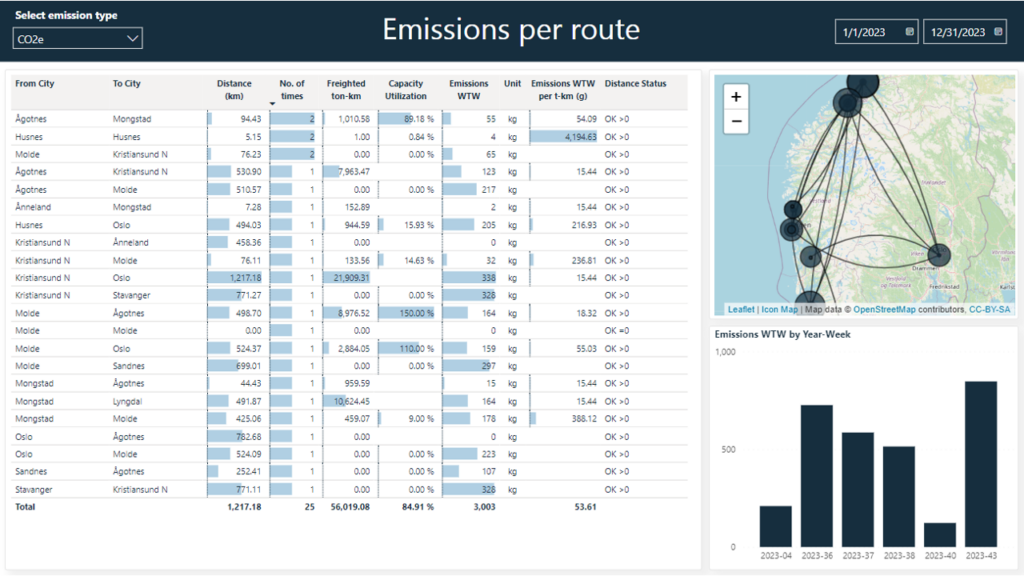
Rather than using this information for purely descriptive purposes—for instance, noting the average catch for each vessel during past months—fishing companies could adopt a forward-looking analytical approach with seafood ERP systems. One analysis might involve mapping fishing activity and catch rate over the course of the season to identify factors which can enhance efficiency and also reduce fuel consumption and running costs. Or rather than just tracking freight costs, companies can use seafood ERP software to track measures which analyze logistics inefficiencies and help improve their carbon footprint resulting from shipping. 

Embracing the new information economy

Although setting up measurable sustainability figures and goals may seem a daunting task, it is a journey that all companies will eventually need to address to compete in the increasingly environmentally conscious marketplace. Sustainability, just like digitalization through seafood ERP software, can save money and optimize operations. As we make the shift from the automation economy to the information economy, from traceability to sustainability—defined by the use of data and insights from seafood ERP systems for making smarter, more intelligent decisions—there’s never been a better time to embrace both.
Want to know more about how Maritech can support your sustainability journey?

Seafood Traceability 2.0 

Navigating the Seafood Traceability Landscape

Meeting modern demands with advanced solutions

In today’s market, seafood traceability goes beyond meeting basic legal requirements.

Consumers want to know that the seafood they choose is of top quality and has been responsibly produced. For you, heightened seafood traceability awareness means that more data must be collected and verified, including an ever expanding and more transparent set of checks.

Meeting and exceeding the seafood traceability challenge

Seafood products are subject to extensive regulatory programs – the Seafood Hazard Analysis Critical Control Point (HACCP), the National Shellfish Sanitation Program (NSSP), the Seafood Import Monitoring Program (SIMP), FDA tracking regulations, and more. Sorting out how all these rules align and how they can be incorporated into your existing seafood software can be confusing. Especially for small producers or traders, the burden can seem onerous and expensive.

As consumers become ever more environmentally conscious, it is clear that just meeting the minimum legal standards for fish traceability will not be enough for seafood companies to be successful in the coming years. You must be able to measure and report on how you are meeting not just the legal mandates, but also sustainability standards, set both now and as goals for the future.

Customer case Silver Seafood - Maritech

Future proofing seafood traceability

This means that companies must have a seafood traceability system that tracks more than just basic one up one down lot traceability, but also keeps track of hard-earned certifications (such as MSC and Global G.A.P) that follow along with the fish records and provide assurance that the fish meets the most rigorous standards of being responsibly and ethically raised or caught.  

Even more stringent measures, such as the newly implemented MSC Labour Eligibility Requirements (May, 2023) that will audit against illegal and forced labour, are also becoming part of the mandatory traceability landscape. Over the next decade, it will be common for seafood traceability to include verification of tracking data acquired by satellites, used to monitor the location and movement of commercial fishing vessels to combat illegal, unreported and unregulated fishing (IUU fishing). For small producers, keeping abreast of the newest traceability requirements and providing the necessary verification can be an ever-steeper challenge.  

Maritech Quality Tracking - digital checklists linked to keys in your business system

Traceability that is trustworthy

In Maritech, traceability has been in our backbone since the 70’s, and is at the core of our position as the global leader in seafood tech. For decades, we have been in the forefront developing cost-effective tools to manage digital seafood traceability and supply-chain collaboration for seafood companies around the world. 

Landing Note information, which records the verified catch area, fishing trip dates, origin lots, and more has been an integral part of Maritech seafood software systems from the very beginning. Our uniqueness is that we cover the seafood-related processes through all of the value chain, from sea to table – with full traceability, documentation, and control. From landing or aquaculture, through production, processing, packing/labelling, sales, claims, and logistics.

Tools for tracking of MSC, Global Gap, and other major certifications are built into our seafood solutions. This means that even very small producers can comply easily and affordably with an implementation that takes weeks, and not months and years.


By creating simple and powerful cloud solutions that manage all of this information easily, integrated with your normal business transactions, we will, together, steadily and surely remove the barriers to a safer and more transparent seafood supply chain.  

And by investing in advanced seafood traceability software and maintaining rigorous standards, your seafood company will not only meet current demands but also position yourself for long-term success in a competitive and conscientious market.

FDA’s New Traceability Rules for Seafood

A checklist and lessons from Norway


The US seafood industry is facing new challenges as the FDA traceability regulations are set to become official on November 7th. 

The new, strict regulations from the US Food and Drug Administration (FDA) include all food commodities identified on the FDA’s Food Traceability list (FTL), such as finfish (catfish excluded), crustaceans, mollusks, and bivalves, with additional records required for fish obtained from a Fishing Vessel. The traceability record-keeping requirements will affect almost all seafood producers who do business in or with America. With aggressive deadlines, few exceptions, and no phase-in, the proposed rule will make compliance using paper-based or out of date electronic systems nearly impossible. 


Aligning with existing regulations

Seafood products included in the FTL are also subject to the Seafood Hazard Analysis Critical Control Point (HACCP), the National Shellfish Sanitation Program (NSSP), and the Seafood Import Monitoring Program (SIMP), among others. Sorting out how all these rules align and how they can be incorporated into your existing data management systems can be confusing. Especially for small producers, the burden can seem onerous and expensive. Although not mandated, it seems clear that the ability to provide a spreadsheet record to the FDA within 24 hours could only be accomplished if a company is capturing digital records. 

“I talk to producers every day who have already put considerable investment into data compliance and who fear, especially in this inflationary and difficult economic climate, the enormous cost of reviewing and complying with the new rules. It’s going to be difficult for a lot of seafood companies, particularly small-to-midsize harvesters and distributors,” says Kristjan Kristjansson, Sales Manager, Maritech North America.

“Keeping track of everything is painful right now and it’s going to get more painful. There are some companies that aren’t going to be able to make that transition easily without an affordable software partner. If the FDA triggers an audit, without a system in place that can produce the necessary records within hours, it could mean fines, lawsuits, or even being shut down.”


Kristjan Kristjansson,Maritech North America

Norway – the gold standard for seafood traceability

Similar rules have been in place in Norway for many years, and the country has become the gold standard for traceability record keeping. As Maritech has been a trusted partner in seafood technology for more than 40 years, ensuring compliance according to Norway’s even stricter traceability requirements, our systems have been stress tested by some of the largest and most complex seafood companies in the world, whose global trade must meet all standards and regulations. In transitioning our advanced software tools to the cloud, we also make our expertise and best practices available to even the smallest of seafood producers in a simple and cost-effective way.   

“For firms to comply with the new rules, especially small to mid-sized producers, partnering with a software company who fully understands the best way to implement traceability systems in an efficient and cost-effective manner is now more important than ever. With Maritech Cloud, you get sophisticated cloud-based tools tailored for the seafood value chain, with built-in compliance and proven best-practice methodology,” Kristjansson continues.

“Landing Note information, which records the catch area, fishing trip dates, origin lots, and more has been in place for many years in Norway and has been an integral part of Maritech software systems from the very beginning. In our latest pilot project, we have moved this functionality into our native cloud solution, Maritech Purchase & Sales, with planned release functionality developed specifically for the North American market. This means that even very small producers can comply easily and affordably with an implementation that takes weeks, and not months and years.”  


New FDA Rules – Checklist

  • Food Traceability List – Companies that originate, transform or create food on the FTL must assign a new traceability lot code. All key data elements must be linked to the traceability lot code to ensure traceability within the firm and across the supply chain.

  • Seafood Obtained from a Fishing Vessel – First Receivers of seafood obtained from a fishing vessel must create/maintain a traceability lot code and have a mechanism for linking the code to the Harvest date range and locations (National Marine Fisheries Service Ocean Geographic Code or geographical coordinates) for the trip during which the seafood was caught.

  • Key Data Elements – The FDA’s proposed system follows critical tracking events (CTEs) in the supply chain and stipulates capture of key data elements (KDEs) along the way.

  • Data Flow – Firms that ship foods on the FTL would be required to send product origin information, including the traceability lot code, to the receiving firm.

  • Record Keeping Requirements – Under the new mandatory record-keeping procedures, supply chain partners will have to maintain the data in their systems for two years and provide it to the FDA in a sortable, electronic spreadsheet within 24 hours in the event of an outbreak.